AI Scan and Claude Code Review: do they review PHP, and at what cost?
GitHub's AI Scan scans PHP code in pull requests and uses credits even on a public repository. Claude Code Review has no official list of languages, and it's billed by tokens.
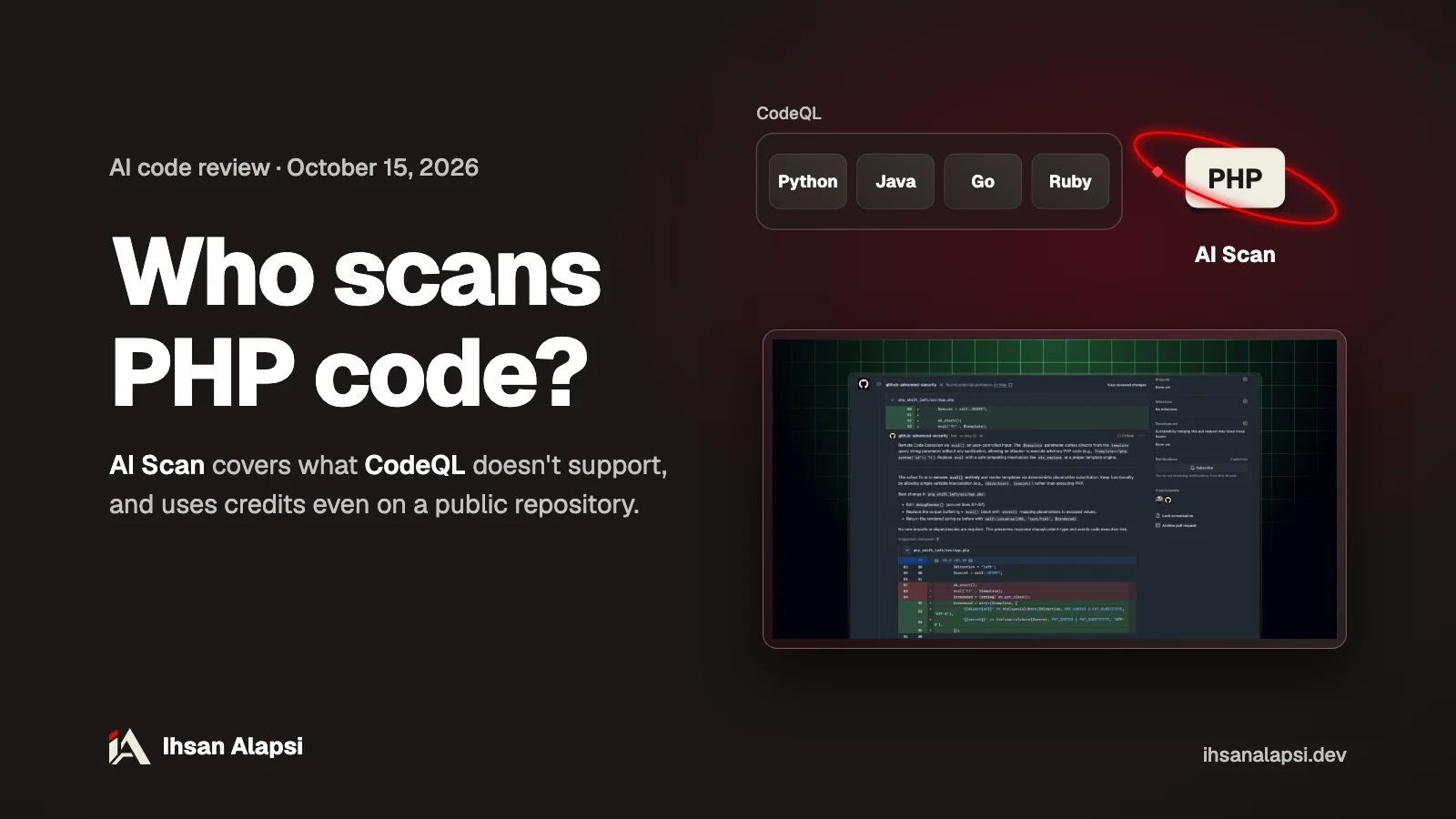
On October 15, 2026, three AI tools for code security and code review became generally available (GA) on the same day: AI Scan and agentic autofix from GitHub, and Code Review from Anthropic as part of Claude Code. If your team is on GitHub and your code is PHP, this news matters to you more than most, because AI Scan scans PHP code. All three are billed by usage.
What does each of the three do?
AI Scan scans the changes in a pull request (or PR) for security vulnerabilities in languages CodeQL doesn't cover. agentic autofix fixes existing security alerts and opens a PR with the fix. Claude Code Review reviews the whole PR and comments on the lines.
Code scanning is the security scan GitHub runs on a repository's code, and its results show up as alerts in the repository and on the PR. CodeQL is the main engine behind this scan: it turns the code into a database and runs queries on it that look for vulnerabilities and bugs (CodeQL docs).
Here's how they compare side by side, based on the October 15, 2026 announcements and each company's docs:
AI Scan | agentic autofix | Claude Code Review | |
|---|---|---|---|
Company | GitHub | GitHub | Anthropic |
What it does | Scans the PR's changes for security vulnerabilities | Fixes an existing alert and opens a draft PR | Reviews the PR for logic errors, vulnerabilities and edge cases |
When it runs | On its own, when the PR opens and after every commit | When you assign the alert to Copilot | Depending on the repository setting: once when the PR opens, after every push, or on request |
Languages | Those CodeQL doesn't cover, including PHP | Code scanning alerts, with verification by CodeQL | The docs page doesn't give a list of languages |
Who can use it | Public repositories, and private ones in organizations with Code Security or Advanced Security, with no Copilot license | Code Security or Advanced Security customers on Enterprise Cloud according to the announcement, and public repositories too according to the docs | Claude Team and Enterprise organizations |
Billing | AI credits from the GitHub account | AI credits and GitHub Actions minutes | By tokens, outside the usage included in the plan |
Does it block merging? | No, its results are advisory | No, the PR is a draft for review | No, and it doesn't approve the PR |
What it skips | PRs from forks or from Dependabot | Alerts outside the default branch | Drafts and forks in automatic reviews |
Does AI Scan find vulnerabilities in PHP code?
Yes. AI Scan is built for languages CodeQL doesn't cover, and according to GitHub's announcement these include PHP, along with Shell/Bash, Terraform (HCL), Dockerfiles, JSP for Java and Blazor for C#.
This matters because CodeQL doesn't support PHP at all: its docs list the languages it supports, and say any language outside the list isn't supported, PHP included. WordPress and Laravel run on PHP (WordPress requirements and Laravel 13 requirements). So the code of a WordPress plugin or a Laravel app was outside CodeQL's coverage, and that's the gap AI Scan is built to fill, according to the announcement.
GitHub's announcement came with a screenshot of a PR with PHP code that passes a value from the URL to eval(). The scan flagged it Critical as Remote Code Execution, because an attacker can send PHP code in the query string and run it. These are the lines the suggested fix removed, as they appear in the screenshot:
ob_start();
eval('?>' . $template);
$rendered = (string) ob_get_clean();
And the fix replaced them with placeholder substitution using escaped values, without running PHP:
$rendered = strtr($template, [
    '{{direction}}' => htmlspecialchars($direction, ENT_QUOTES | ENT_SUBSTITUTE, 'UTF-8'),
    '{{secret}}' => htmlspecialchars($secret, ENT_QUOTES | ENT_SUBSTITUTE, 'UTF-8'),
]);
According to the AI Scan docs, the results appear in the Conversation tab and the Files changed tab next to CodeQL results, each with an AI label. Each result explains the risk, and most come with a suggested fix. The scan doesn't need a build, and it may search the rest of the repository before it flags anything. These are the categories it flags now:
Injection: SQL, HTML or shell commands built from strings without proper escaping.
Weak cryptography, or weak password hashing.
Broken access control: path traversal, missing CSRF protection, and open redirects.
Keys or passwords stored or written to logs without protection.
Risky settings, like running in debug mode.
Authentication problems, like missing TLS or rate limiting.
Unsafe deserialization, or running untrusted content.
SSRF: the server fetches a URL the attacker controls.
Supply chain: packages, actions or images not pinned to a version.
The docs also state its limits: the scan runs on PRs only, its results don't become repository alerts, it doesn't run on PRs from forks or from Dependabot, and it can produce false positives. It also doesn't read instruction files like copilot-instructions.md or CLAUDE.md.
AI Scan had been in public preview since July 14, 2026 for Code Security customers, and it needed a Copilot license and CodeQL analysis turned on with the default setup (the preview announcement). On September 16, 2026 it started working without the default setup (GitHub's announcement of the change), and on October 15 it became generally available and no longer needs a Copilot license.
What does agentic autofix do?
agentic autofix takes a code scanning alert on the default branch, searches the repository's files, writes a fix, and reruns the CodeQL scan to confirm the alert is closed. Then it opens a draft PR with a summary of the fix and the verification steps.
According to GitHub's announcement, you assign the alert to Copilot with the Assign to Copilot button, or you pick up to 25 alerts for it to fix in a single PR, or you use the REST API. An alert that only shows up on a PR or on another branch can't be assigned to Copilot.
When you turn it on, the Assign to Copilot button takes the place of the free Generate Fix button. The old button is Copilot Autofix: one suggested edit for one alert, which you apply yourself, and it doesn't use AI credits (autofix docs). Each agentic autofix session, on the other hand, uses AI credits and GitHub Actions minutes.
The announcement limits agentic autofix to Code Security or Advanced Security customers on GitHub Enterprise Cloud, after the enterprise admin (the enterprise account on GitHub) turns on the "Agentic autofix" policy, and with a Copilot payment method. But the docs page on enabling it, updated on the same day, adds public repositories on GitHub.com, and says the admin of a public repository in a personal account can turn it on directly.
For a PHP team, agentic autofix doesn't give much on its own: verification runs through CodeQL, and CodeQL doesn't produce alerts for PHP. And if you use another tool that scans PHP and uploads its results to GitHub, the docs say it can't confirm the fix for that tool's alerts.
What does Claude Code Review do?
Claude Code Review reviews PRs in GitHub repositories: several agents read the change and the code around it, a verification step removes wrong findings, and what's left comes out as line comments ranked by severity. Anthropic calls it Code Review, part of Claude Code.
According to the Code Review docs, the review looks for logic errors, security vulnerabilities and broken edge cases. By default it focuses on bugs that break production, not on formatting or test coverage, and you can change what it flags with REVIEW.md and CLAUDE.md files in the repository. It reads the diff and the code around it without building or running the code, and its access to the repository is read only. On the PR it leaves comments, a summary, and a check run called Claude Code Review, which never concludes as a failure. The docs page doesn't give a list of languages, so there's no official statement about PHP specifically.
Anthropic's announcement says most reviews now finish in 6 to 10 minutes, down from about 20 minutes during the research preview. There are now 3 levels the admin picks for each repository: Quick, Standard (the default) and Deep, and the deeper one takes longer and costs more.
The service is for Claude Team and Enterprise organizations, on GitHub and GitHub Enterprise Server. It doesn't work for organizations that have Zero Data Retention or the HIPAA setting turned on, and not yet for organizations that use their own encryption keys (CMEK). Automatic reviews skip drafts and PRs from forks, and anyone with write access can request a review with a @claude review comment. And on any plan, there's a /code-review command inside a Claude Code session, but that's a different thing from the service.
How much do they cost, and what is free in practice?
All three are billed by usage. AI Scan and agentic autofix use Code Security AI Credits even on a public repository, and Claude Code Review is billed by tokens with no fixed price per review. What's free on a public repository is CodeQL and the Generate Fix button.
With GitHub
AI Credits are the unit GitHub uses to bill AI features, like Copilot and these two features. The usage-based billing page that the announcement links to says one credit is $0.01. And the Advanced Security billing page says AI Scan and agentic autofix use Code Security AI Credits "even when the repository is public", although they don't need a license there.
An organization's repository is billed to the organization or the enterprise that pays for it. A public repository in a personal account is billed to its owner, unless the owner has a Copilot license from an organization or an enterprise, in which case it's billed there. If the account has credits included with Copilot, those are used first: 1,900 credits a month per user on Copilot Business, and 3,900 on Copilot Enterprise, and the credits are pooled across users. After that, billing is by usage. And if you set a hard budget and it runs out, AI Scan produces no results until you raise it or a new billing month starts.
The AI Scan docs don't give a number for how much a single PR uses, so you find that number by testing on your own repository.
With Anthropic
The costs page says Claude Code Review is billed by tokens from usage credits, outside the usage included in your plan, and to the organization, not the developer. The cost of a review grows with the level, the size of the change, and the complexity of the code around it. A new repository starts on "after every push", so the cost multiplies by the number of pushes. You can set a monthly cap for the service, and when it runs out, reviews stop and a comment appears on the PR saying why.
In the research preview announcement (March 9, 2026), Anthropic said a review costs $15 to $25 on average, depending on the PR's size and complexity. The GA announcement gave no new number, and the three levels came with it.
Paid, eligible Claude Enterprise organizations can get promotional credits of $10,000 to $50,000, depending on the number of active Claude Code seats. They can be requested once, from October 15, 2026 to January 15, 2027, and they expire 30 days after the request. Team, Pro, Max and Free plans aren't included, nor are organizations that pay through a reseller or are on a trial.
What's free on public and private repositories?
Tool | Public repository | Private repository |
|---|---|---|
CodeQL | Free | Needs Code Security |
Copilot Autofix (Generate Fix button) | Free, and uses no AI credits | For organizations with Code Security |
AI Scan | No license needed, but uses AI credits | For organizations with Code Security or Advanced Security, and uses AI credits |
agentic autofix | Available according to the docs, and uses AI credits and Actions minutes | For organizations with Code Security or Advanced Security, and uses the same |
Claude Code Review | Team or Enterprise plan, billed by tokens | Same |
Does AI review replace a human review?
No, and both companies say so in their docs. GitHub says AI Scan results can include false positives, and that you need to review and test agentic autofix fixes before merging. Anthropic says a review with no comments doesn't mean the code is free of bugs or secure.
And a WordPress plugin written years ago that nobody has touched won't get its code scanned, because AI Scan runs on PRs only, and a full repository scan isn't supported.
AI Scan and Claude Code Review read the PR's code, and they don't test the platform while it's running: permissions on real data, server settings, and the payment flow. Muhassan finds the vulnerabilities in your platform before someone else does, and hands you a clear fix plan.
Where do you start now?
Pick one repository and test on it before you roll out, and make the budget your first step.
How do you turn on AI Scan for a public repository?
On a public repository in your personal account, whoever has admin access turns on AI Scan with a single toggle under Code scanning, as long as code scanning is turned on. These are the steps from GitHub's docs:
Open your account's billing settings, check whether you have included AI credits, and set a budget for Code Security AI Credits. That way you have a cap before the first PR is scanned.
Open Settings in the repository, and in the Security and quality section of the sidebar click Advanced Security. You'll see the Code Security settings.
Make sure GitHub Actions is turned on, then next to CodeQL analysis choose Set up, then Default, and click Enable CodeQL. Now code scanning is running.
Turn on the AI Scan for pull requests toggle under Code scanning.
Open a PR that changes a PHP file, from a branch in the same repository, not from a fork. The results appear in the Conversation and Files changed tabs with an AI label next to them, and rate each one with the thumbs up or thumbs down button so GitHub can improve the scan.
If your repository is PHP only: the AI Scan docs say it doesn't need the CodeQL default setup, and it works even if CodeQL analysis failed or is pending. The condition is that code scanning is turned on in the repository, so after step 3 make sure the AI Scan toggle shows up for you.
An organization repository works differently. The organization owner or a security manager turns on AI Scan for the organization, repositories inherit the setting, and a repository admin can only opt their own repository out. If the organization is under an enterprise, the policy is set to "Not allowed" by default. And watch out: turning it on at the organization level starts AI Scan right away on every eligible repository, and PRs can use credits before anyone has time to opt their repository out.
How do you try Claude Code Review in your organization?
If your organization is on Claude Team or Enterprise, Anthropic's costs page suggests a small trial:
Set a monthly cap for the Code Review service in the usage settings.
Turn it on for a few repositories that look like your usual work, and set each one to "once after the PR opens" or "on request".
After a few reviews, read the average cost per repository in the admin dashboard, and multiply it by the number of PRs opened each month.
If your organization is on Claude Enterprise and eligible for the promotional credits, turn on Code Review for your repositories before you request the credits, because the 30 days start from the moment you request them.
If you want a review that you run yourself on your project, I'm preparing the Security Skill Pack: skills that review your project's code and flag IDOR and permission bugs before you deploy.
To be upfront: I build skills for Claude Code and other AI tools (AI skills), so keep that in mind as you read this comparison.
Is your main code PHP, or a language CodeQL already covered? Your answer tells you whether AI Scan adds anything for you.
FAQ
Is AI Scan free on a public repository?
No. It runs on a public repository without a Code Security license, but it still uses Code Security AI Credits there. If the paying account has credits included with Copilot, the scan uses those first, and after that it's billed by usage.
Do I need a Copilot license to use AI Scan?
No. GitHub says plainly that AI Scan doesn't need a Copilot license. But if your public repository is in your personal account, and an organization or an enterprise gave you a Copilot license, the scan is billed to them and uses their included credits first.
Do AI Scan or Claude Code Review block merging a PR?
No. AI Scan results are advisory: they don't fail the code scanning check and can't be set as a merge condition in rulesets. Claude Code Review doesn't approve or block, and its check run doesn't conclude as a failure. The merge decision stays with your team.
Does AI Scan scan the old code already in the repository?
No. AI Scan scans pull request changes only, a full repository scan isn't supported, and its results don't become repository alerts. Old code only gets scanned when a new change touches it.
Does Claude Code Review work on GitLab?
No. The service is for GitHub repositories only, including GitHub Enterprise Server. On GitLab, Anthropic's docs mention another option: run Claude in your CI with GitLab CI/CD, using a Claude API key or a cloud provider account.
What is Anthropic's $10,000 offer?
Promotional credits for Claude Code Review, for paid, eligible Claude Enterprise organizations, from $10,000 to $50,000 depending on the number of active Claude Code seats. They can be requested from October 15, 2026 to January 15, 2027, and they expire 30 days after the request. The Team plan isn't included.