Microsoft open-sourced Agensh: 1,024 coding agents, no orchestrator
On Oct 24 Microsoft Research open-sourced Agensh under MIT: a harness scaling coding-agent teams to 1,024 agents with no central orchestrator, with published results on the hardest ProgramBench tasks.
When you run a team of coding agents, a central orchestrator becomes the bottleneck: every agent waits for it, and every decision passes through it. Microsoft Research open-sourced Agensh under the MIT license on Oct 24, 2026: a harness that removes that orchestrator and has been tested with up to 1,024 agents. Its numbers are published with a guide for rerunning the experiment yourself.
What is Agensh?
Agensh is a self-organized multi-agent harness that scales to 1,024 agents. Agents discover and claim sub-tasks, share findings, verify results and merge their work asynchronously, with no central orchestrator.
Every agent runs the same loop: gather context, claim a sub-task, act, verify the result, merge its progress, and repeat until the user's goal is reached. The shared infrastructure has three parts: a shared workspace on Gitea, a messaging interface on Mattermost, and a shared context board adapted from DeLM. In the published experiment, each agent runs on top of the Copilot CLI agent loop.
With no central orchestrator, there is no single point that stops the whole team when it stalls, and agents work in parallel on different sub-tasks. According to the repository, all agents start with the same role, and specialized roles and coordination workflows emerge on their own as the team grows.
What did the experiment prove, in numbers?
On the five hardest ProgramBench tasks, the mean test-pass rate rose from 19.31% with one agent to 28.78% with 128 agents, a relative improvement of about 49%.
ProgramBench asks agents to rebuild reference programs from their observed behavior and bundled documentation, with no internet access and a six-hour budget. The measured number is the share of tests that pass on the program they built. The model was GPT-5.6-sol at high reasoning effort, and all the numbers come from the Agensh repository.
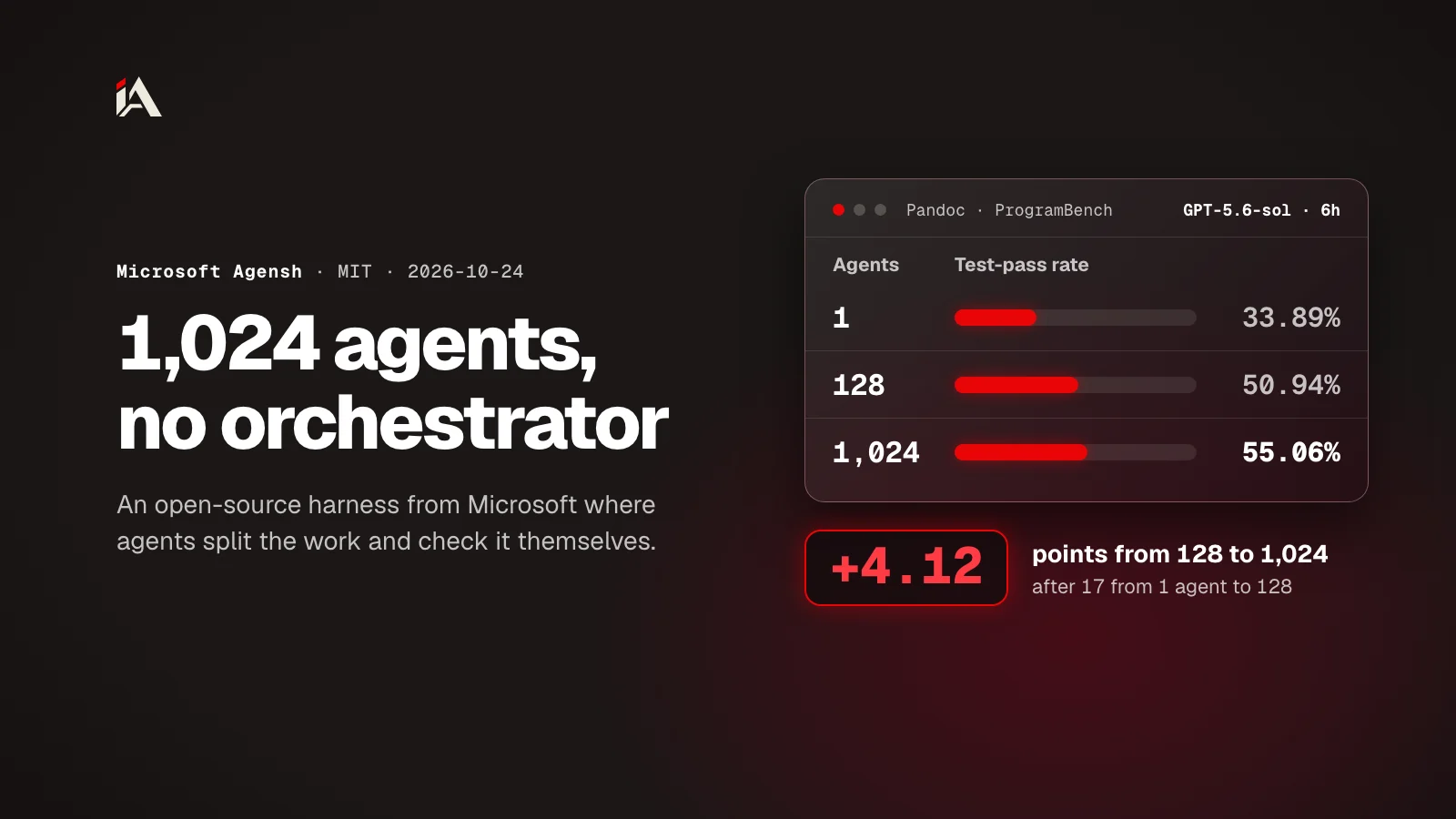
Agents | Mean on 5 tasks | Pandoc |
|---|---|---|
1 | 19.31% | 33.89% |
128 | 28.78% | 50.94% |
1,024 | not reported for the mean | 55.06% |
On Pandoc, the rate rose about 17 points from one agent to 128 agents, then only about 4 points from 128 to 1,024.
A newer result in the repository with GPT-6.1-sol takes the Pandoc rate from 56.19% with one agent to 79.59% with 32 agents, a relative improvement of 41.64%. The repository has not published numbers for this model above 32 agents.
What is new on Oct 24, and what is not?
What is new is the code itself; the research paper has been on arXiv since Sep 22, 2026.
The repository's News section says: "2026-10-24: We open-sourced Agensh, including the harness, experiment launch scripts, and reproduction guide." The release includes a single-node team setup using Docker Compose and a standalone single-agent baseline, both using native Copilot ACP sessions.
So if you read about Agensh as if it were research from this week, the preprint is from September and the code is from Oct 24. The code is what lets you rerun the experiment yourself. The guide itself says the release infrastructure has changed since the original experiment, so your run may not match the published numbers exactly.
How do you try it yourself?
The reproduction guide in the repository runs the same ProgramBench experiments: a single-node team, and a single-agent baseline to compare against.
Clone the
microsoft/Agenshrepository from GitHub.Set up a Linux machine with Docker Compose, and install ProgramBench separately, following the reproduction guide. The defaults are 8 agents and 6 hours per task on gpt-5.6-sol, so you need a model gateway that serves it, and its token.
Run the single-node team setup with Docker Compose.
Run the single-agent baseline on the same task, and compare the test-pass rate and the time in numbers.
If you want to scale, scale step by step: from 1 agent to 8, then to 32, measuring at each step, because the published numbers do not always go up with each increase: on the ctags task, 8 agents scored 18.47% against 25.82% for 1 agent.
Do not put Agensh in the same box as everyday coding tools. A nearby project is AWS's open-source Infinity, which solves a different problem: how an agent waits for a tool result without burning compute. Agensh solves how a thousand agents coordinate. Both are open source, and both are for teams building agent infrastructure.
When does it not fit?
If your work is one agent on a clear, limited task, Agensh adds complexity with no benefit.
If you have no experience running agent teams and measuring their results, this research harness will cost you more setup time than it gives back. Its numbers were also measured on the Copilot CLI loop, so if your team uses another agent tool, the published numbers do not apply to you directly.
But if you face a large refactor or a full codebase migration, and your team measures its work in numbers, Agensh is a free, open-source design reference for trying scale without a central orchestrator. Try it on a small task first, measure, then decide whether scaling is worth it.
And if you are already building coding agents, Kimi K3.1 Pro matters on the model side: Moonshot's numbers put it close to Claude at coding, and Moonshot has promised the open weights by Nov 4.
For ready-made tools and skills for coding agents, see the AI skills section.
FAQ
Is Agensh a ready product I can run on my project?
No. It is open-source research infrastructure, and the release is built to reproduce the ProgramBench experiments: a single-node team on Docker Compose, a single-agent baseline and a reproduction guide. The guide does not cover running it on your own codebase.
Is the research paper new?
No. The preprint appeared on arXiv on Sep 22, 2026. What is new on Oct 24 is the open-source code itself: the harness, the experiment launch scripts and the reproduction guide.
Do more agents always mean better results?
Not always. The mean over the five tasks rose at every team size measured, but on ctags, 8 agents scored 18.47% against 25.82% for 1 agent. On Pandoc the test-pass rate went from 33.89% with 1 agent to 50.94% with 128 and 55.06% with 1,024, so the big jump happened before 128. The cost was not disclosed.
Does Agensh work with tools other than Copilot?
Not in the current release. The published experiment builds on the Copilot CLI agent loop, and the release uses native Copilot ACP sessions. The paper says the design can connect to other tools, such as Claude Code, through a small adapter for each one, but the published release ships no adapter beyond Copilot.