MongoDB Compass before 1.53.1 trusts recoverable eMudhra certificates
On Oct 24 MongoDB warned: Compass before 1.53.1 trusts certificates issued by eMudhra intermediate CAs described as recoverable, because the app relies on Electron's own certificate store. Update to 1.53.1.
Many developers open MongoDB Compass every day to browse databases, and rarely think of it as an attack surface. On Oct 24, 2026, MongoDB published an alert about the app itself: versions before 1.53.1 trust certificates issued by eMudhra intermediate CAs, which the alert describes as "recoverable." The score is 7.6, and the fix is a single update.
What is wrong with Compass before 1.53.1?
MongoDB Compass before 1.53.1 trusts certificates issued by eMudhra intermediate CAs whose keys became "recoverable." The flaw is CVE-2026-115929, scored 7.6, and only Compass is affected, in every version before 1.53.1.
The alert is on MongoDB's alerts page under the title "MongoDB Compass trusts certificates issued by recoverable eMudhra intermediate CAs." "Recoverable" here means the intermediate CA keys ended up within reach of people other than their owners, so they are exposed, and the certificate no longer works as proof of identity. If your app still trusts those intermediates, it trusts an identity someone else can pretend to hold.
What is a trust chain, and why does one intermediate break it?
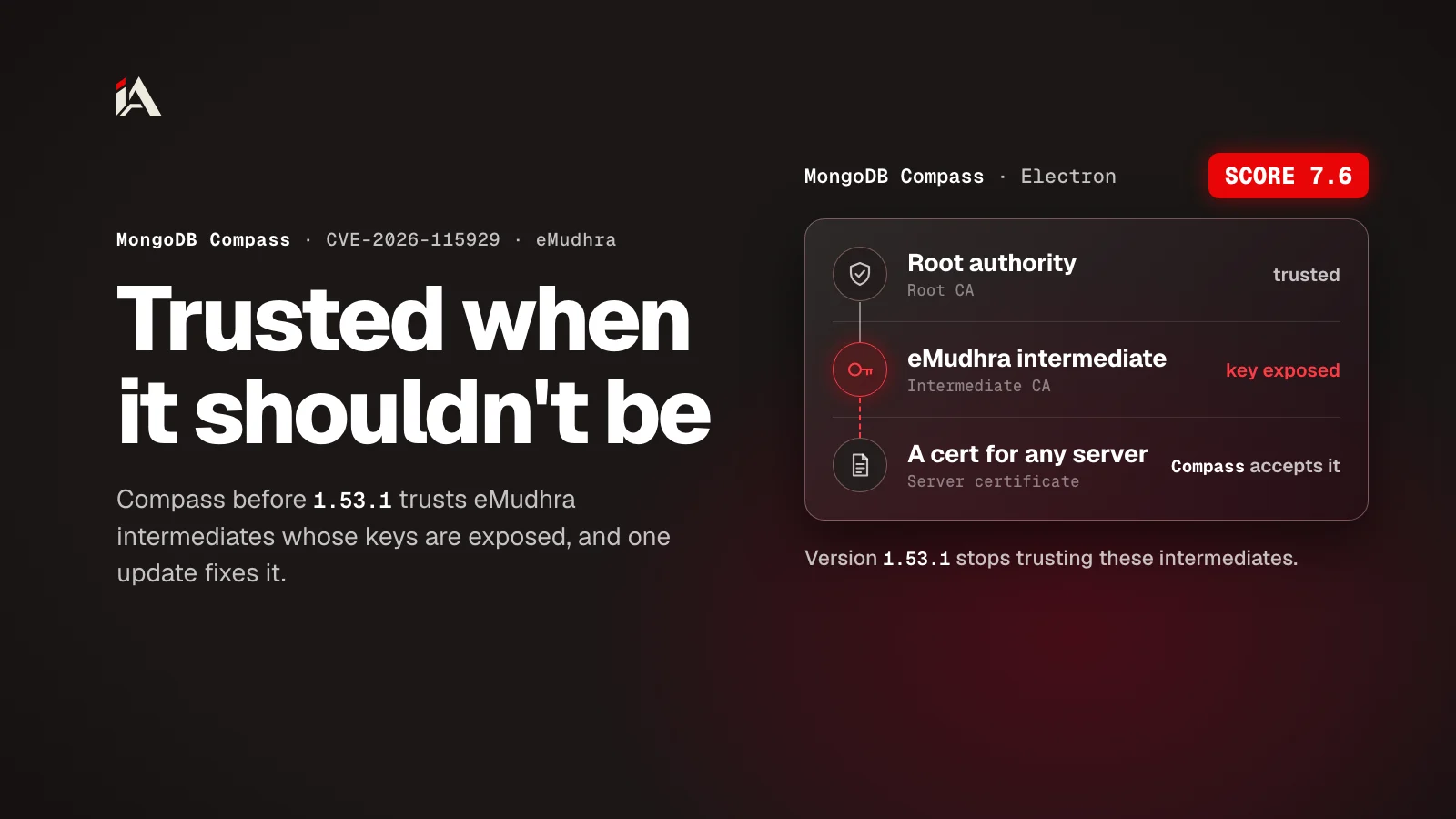
A trust chain is the path from a server's certificate up to a trusted root, and any intermediate in it can sign certificates your app accepts. So if one intermediate's key is exposed, the whole chain breaks.
A server certificate does not work alone. It is the last link in the chain: the root signs an intermediate certificate, and the intermediate signs the server's certificate. Your app trusts the server because it trusts the root, and the root is what signed the intermediate.
If the intermediate's key is exposed, anyone holding the key can sign a certificate for any name, and an app that still trusts the intermediate will accept it. So the fix is to stop trusting the intermediate entirely, which is what the update does: the new Compass version no longer trusts those intermediates.
Why Compass specifically?
Compass relies on Electron, a third-party runtime with its own TLS certificate store. So Compass checks Electron's store to decide which certificates to trust, not your operating system's store. And while Electron's store still trusts the eMudhra intermediates, Compass trusts them along with it, even if your system or browser stopped trusting them.
In the Compass 1.53.1 release notes, the fix is an update of Electron itself, tied to the same CVE number.
The same goes for any program that carries its own certificate store: updating the operating system alone does not fix it, and the program itself must be updated.
What does this mean for your database connection?
When you connect to a server in Compass, the certificate is what proves the server is the right one, not someone pretending to be it. If Compass trusts a certificate from an intermediate whose keys are exposed, that guarantee weakens.
If someone holds a certificate from those intermediates and can intercept your connection on the network, they can present themselves as a trusted server. The Electron advisory sets the same condition: the risk is for apps that make TLS connections over a network an attacker can intercept.
MongoDB's alert mentions no observed exploitation and no specific targeted servers. But trust in certificates is the basis of the encrypted connection, and any hole in it deserves an immediate update, even with no known attack today.
What should you do now?
The steps are three: check your version, update, and repeat on every machine.
Open Compass and check your version number. If it is below 1.53.1, you are affected.
Update to 1.53.1 or later, from Check for updates in the MongoDB Compass menu or from the download page. This is the action the alert names. And if automatic updates are on, Compass does not apply the new version until you close it and open it again.
If you have Compass on other machines, update it there too. Each machine has its own copy, and an old version on an old laptop stays affected.
The same eMudhra incident reached Node.js: the October Node.js security releases updated its bundled CA certificates because of it. So if you have services or scripts on Node, update them too.
When did you last update your desktop tools?
Published servers and apps get all the attention, while desktop tools stay on old versions for months because they "work." But Compass holds the logins to your databases and connects to them every day, so an old version of it is not a small detail. Update today, then go through your other tools.
Next.js projects have a security update this month too: the October 2026 Next.js flaws tell you which version to upgrade to.
And if you want someone to find the holes in your platform and its connections before anyone else does, Muhassan tests your platform and hands you a clear fix plan.
FAQ
Is the MongoDB server itself affected?
No. The alert covers Compass only, the desktop app you browse databases with. The MongoDB server is not mentioned in the alert.
Is there a workaround besides updating?
The alert lists no workaround. The stated action is updating to 1.53.1 or later; all earlier versions are affected.
Do I need to change passwords after updating?
The alert does not ask for password or secret rotation. Updating is all it asks for. If you connect to databases over public networks, reviewing your connections is general caution, not a request from the alert.
How do I know if my version is affected?
If your Compass version number is below 1.53.1, you are affected. If you cannot find the number, click Check for updates in the MongoDB Compass menu: if a newer version exists, Compass offers to install it.